

Where does the rain go next?
Follow water through the atmosphere, across the land, and below the surface.
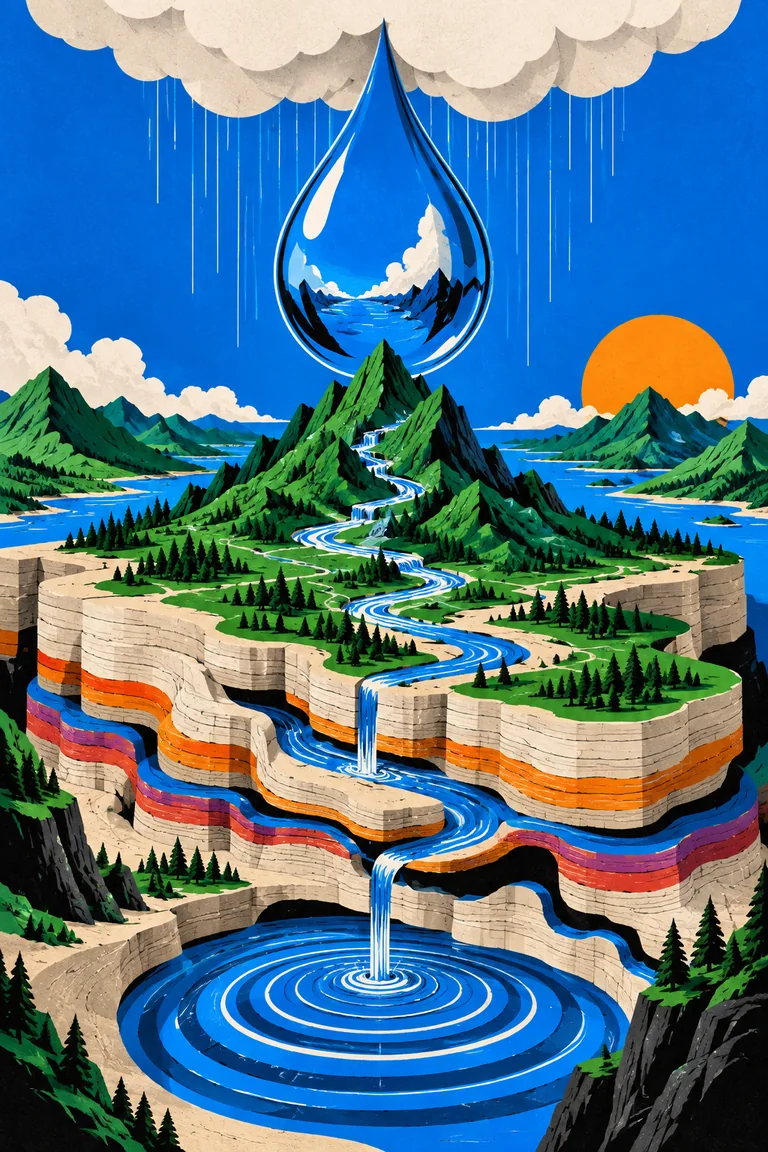
LET’S TAKE
A CLOSER LOOK.
Choose a step or follow the sequence.
The complete explanation is here, too.
Water moves into the air
Energy from the sun helps liquid water become water vapor. Plants also release water through transpiration.
- 01 / EVAPORATE
Water moves into the air
Energy from the sun helps liquid water become water vapor. Plants also release water through transpiration.
- 02 / CONDENSE
Clouds take shape
Water vapor can condense into droplets. Clouds can also contain ice crystals.
- 03 / PRECIPITATE
Water returns to the surface
Water falls as rain, snow, or other forms of precipitation when conditions allow.
- 04 / RUNOFF
Some water travels over land
Water can flow across the surface and through streams and rivers toward larger bodies of water.
- 05 / INFILTRATE
Some water enters the ground
Water can soak into soil and move into groundwater. It may remain stored or later return to surface water.
- 06 / RECONNECT
There is more than one path
Oceans, air, ice, soil, and groundwater store water. Transfers between them form a connected system rather than a single simple circuit.
What this model covers.
An introductory model. Water follows many paths, with very different residence times; this is not one fixed loop that every drop completes.
GO TO THE SOURCE · OPENS A NEW TABUSGS · The water cycleAn authored visual explanation. The illustration is a metaphor; the steps describe a simplified model.
ANOTHER QUESTION.
ANOTHER WAY IN.
What happens when you pay online?
Follow a payment from checkout to confirmation—and see why “processing” is not the same as “paid”.
How does a name find a website?
From a familiar address to a server: meet the lookup that gets you to the right place.
Why does a smaller gear make a big difference?
Connect your pedals, chain, and wheels—and see how a gear change changes the effort.